WHO representative stresses road safety as key to public health
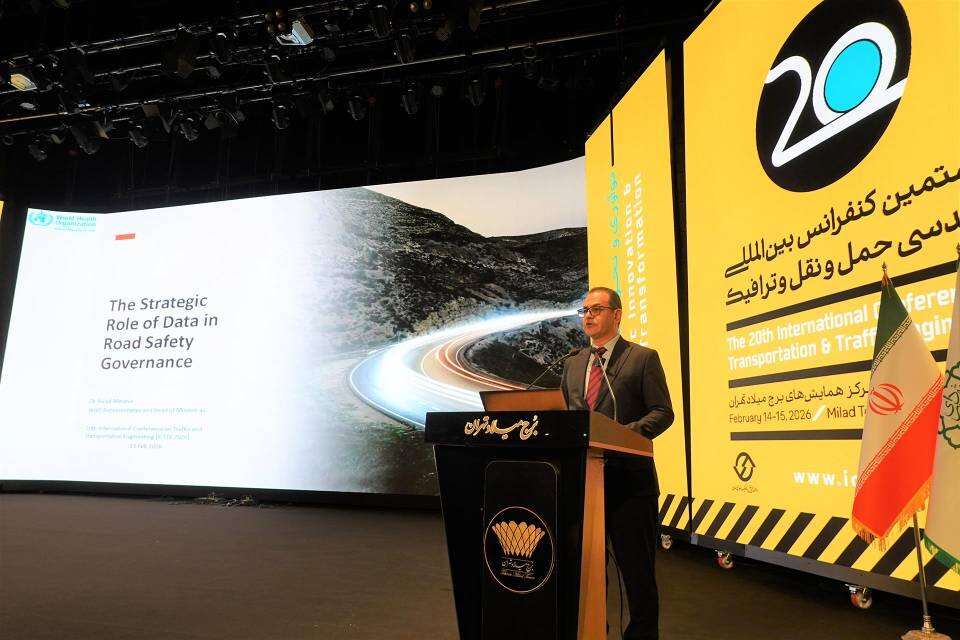
TEHRAN – Awad Mataria, the acting World Health Organization (WHO) representative in Iran, has highlighted the critical role of road safety as one of the most urgent intersections of engineering and public health.
While engineering innovation is vital, the strategic role of data is key to transforming technical knowledge into life-saving governance, the WHO website announced in a press release on February 17.
“Preventing road traffic injuries requires contributions from many disciplines,” Mataria noted.
He made the remarks at the 20th International Conference on Traffic and Transportation Engineering (ICTTE), which was held from February 14 to 15 in Tehran.
Addressing an audience of distinguished professors, engineers, policy-makers, and law enforcement officials, Mataria underscored the critical role of data integration in saving lives.
“Conferences like ICTTE matter because they bring together the knowledge needed to design safer mobility systems.”
According to WHO data, road traffic injuries claim approximately 1.19 million lives annually worldwide and remain the leading cause of death for young people aged 5 to 29.
A central theme of the keynote speech was the transition from viewing data as a mere technical output to utilizing it as actionable intelligence. Mataria observed that when engineering, crash, hospital, and enforcement data are integrated, they enable decision-makers to identify high-risk environments and allocate resources effectively.
“Data is not simply a technical output of transport systems. It is the foundation of effective road safety governance,” Mataria remarked. “In short, data connects engineering solutions to life-saving outcomes.”
The acting WHO Representative acknowledged the Islamic Republic of Iran’s strong foundation in transportation engineering, specifically citing the country’s growing expertise in smart transportation systems, traffic modelling, and infrastructure design. He recommended that the next strategic step should be ensuring that this scientific capacity is systematically connected to decision-making bodies.
Mataria outlined a tripartite approach to reducing road traffic injuries through evidence, governance, and implementation. He emphasized that countries achieving sustained reductions in traffic deaths are those that invest heavily in data integration and analytics, which support the move from reacting to crashes to preventing them.
In his closing reflections, Mataria offered a powerful vision for the future of road safety: “Road traffic injuries are preventable. Engineering innovation makes prevention possible. Data makes prevention precise. Leadership makes prevention happen.”
In December 2025, the National Road Safety Commission (NRSC), in cooperation with the WHO Country Office in Iran, organized a high-level consultation workshop on motorcycle safety and helmet standards, under the United Nations Road Safety Fund (UNRSF) 2024 workplan in Tehran.
The workshop was held on November 19 at the Iranian National Museum of Medical Sciences History.
The event convened representatives from government authorities, technical institutions, and civil society to drive a unified approach to reducing motorcycle-related deaths and injuries, the WHO website announced in a press release on December 24.
Although certified helmets are available in the Islamic Republic of Iran, affordability constraints, counterfeit products, and the scarcity of child-appropriate helmets undermine safe and consistent helmet use. Congested urban environments, limited training, and inconsistent compliance with traffic rules compound the problems, and fragmented data across police, health, and transport systems further limit effective enforcement and strategic decision-making.
Motorcyclists constitute a significant proportion of the fatalities, estimated to be around 40 percent on urban roads and approximately 20 percent on inter-city roads. Surveys show that in the first six months of the year 2025, approximately 48 percent of traffic accident victims in Tehran city were motorcyclists.
The workshop allowed stakeholders to review existing gaps, compare national practices with international best practices and evidence, and explore options for strengthening helmet standards, upgrading enforcement mechanisms, and aligning regulations with internationally recognized frameworks such as UN Regulation No. 22.
Through interactive discussions, participants mapped behavioural, economic, regulatory, and institutional challenges. Discussions highlighted the need for coordinated multisectoral action bringing together the NRSC, Traffic Police, the Ministry of Health and Medical Education, Institute of Standards and Industrial Research of Iran (ISIRI), municipal authorities, academia, civil society, and private-sector partners to advance motorcycle safety at scale.
The consultation concluded with a set of actionable next steps, including strengthening helmet legislation, upgrading national standards, enhancing data systems, expanding public awareness initiatives, and reinforcing market surveillance and enforcement capacity, which together will enhance road safety and protect millions of motorcycle users across Iran.
Leave a Comment